

These fascinating numbers, for which no one, until today, has been able to define the rules that determine their positioning in relation to the other natural integers.
Since the dawn of mathematics, the enigma of their distribution has fascinated.
But why? Why has it taken so long to find a solution? Why can’t anyone?
If no one has found it, it’s because something is missing. The element that led all the researchers astray was to have taken 2 and 3 into account when trying to determine the distribution of prime numbers.
But 2 and 3 have nothing to do with 6n +- 1, and for good reason: they’re the only prime numbers that aren’t of the form 6n -+ 1.
Let’s take a look at the sequence of prime numbers less than 100, and see what it looks like.
2; 3; 5; 7; 11; 13; 17; 19; 23; 29; 31; 37; 41; 43; 47; 53; 59; 61; 67; 71; 73; 79; 83; 89; 97
At first glance, there’s no apparent logic; the intervals between two consecutive primes are variable. Often, two consecutive primes are separated by only one unit. These are the so-called twin primes.
Yet there must be a logic, because without logic, our calculations would always be wrong, if the primes appeared in a disordered or illogical order.
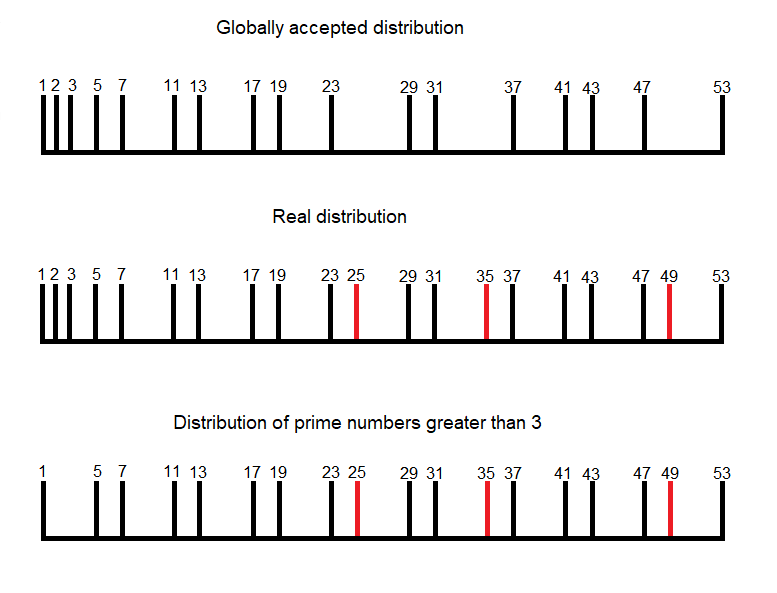
Let’s establish the sequence of natural numbers limited to 100, eliminate the multiples of 2 and 3, which are the smallest divisors apart from 1, which divides everything, and here’s what we get.
1; 5; 7; 11; 13; 17; 19; 23; 25; 29; 31; 35; 37; 41; 43; 47; 49; 53; 55; 59; 61; 65; 67; 71; 73; 77; 79; 83; 85; 89; 91; 95; 97
Now we have two sequences. We’ll take the numbers from our first sequence, that of prime numbers, then we’ll subtract them from the second sequence, that of the survivors of the sieve of 2 and 3, and here we have a third sequence that corresponds to this:
1; 25; 35; 49; 55; 65; 77; 85; 91; 95
So, in this last sequence, we list all the prime numbers below 100 and all the multiples of 2 and 3.
What do these numbers correspond to?
If you find out, leave a comment. If not, find out here
 nombrespremier.fr